Installation Costs & Estimates
Solar Panel Installation Cost in 2026: Price Breakdown by Size and Equipment
How much a home solar installation costs in the U.S., how price per watt works, and how system size, panels, roof and equipment change the total, with worked examples.
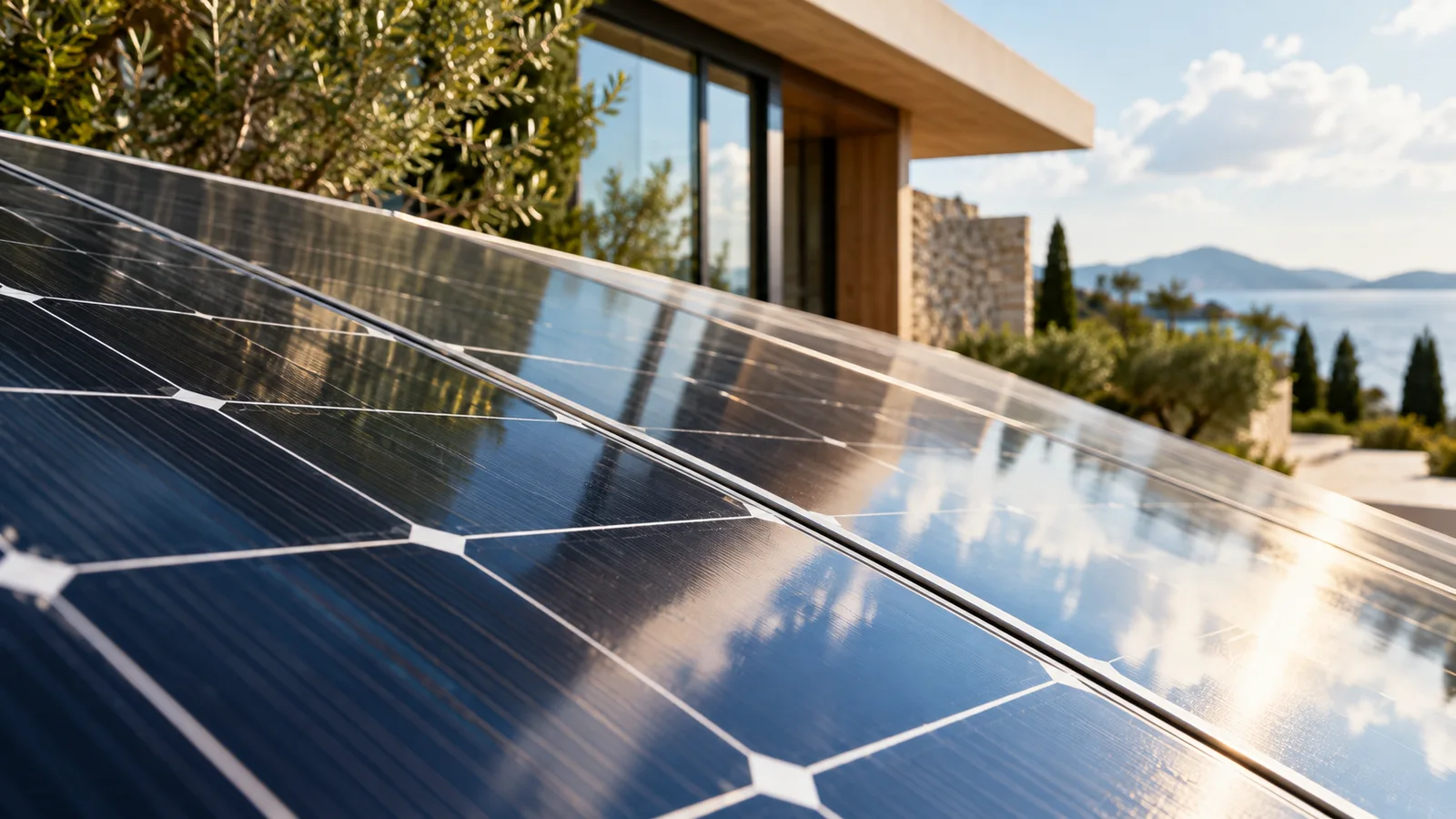
The cost of a residential solar installation in the United States is usually quoted as a price per watt multiplied by the size of the system, and the answer for your house depends on that size, your equipment, your roof and your local market. A typical proposal for a mid-sized home lands in the tens of thousands of dollars before incentives, but the only number that matters is the one written on a quote for your roof. This guide shows how that number is built so you can test any proposal against simple arithmetic.
All dollar figures below are illustrative examples chosen to make the math easy to follow. They are not current market averages. For market-level data, see the National Renewable Energy Laboratory (NREL) and the Department of Energy, linked at the end.
Start with price per watt
Installers size a system in kilowatts of direct current (kW DC), which is the combined nameplate rating of all panels. The headline price is then expressed as dollars per watt (often written $/W).
The formula is simple:
An 8 kW system is 8,000 watts. At an illustrative $3.00 per watt, the total would be 8,000 x $3.00 = $24,000. If another installer quotes $3.40 per watt for the same size, the total is 8,000 x $3.40 = $27,200, a difference of $3,200. Price per watt is the fastest way to compare proposals that use different system sizes.
Two cautions apply. First, make sure each quote states whether the price is before or after incentives, because some proposals show a lower number that already subtracts an assumed credit. Second, check whether the price per watt refers to DC capacity or to the AC output of the inverter, since the two figures differ.
What sits inside the price
A quote bundles several cost groups. The proportions vary by installer and region, so treat the list as a map rather than a formula.
| Cost group | What it covers | Notes |
|---|---|---|
| Panels (modules) | The photovoltaic panels | Efficiency and brand tier change the cost per watt |
| Inverter(s) | String inverter, microinverters or power optimizers | Microinverters usually cost more but give panel-level monitoring |
| Racking and mounting | Rails, flashing, attachments | Roof type (shingle, tile, metal) changes the hardware |
| Electrical | Wiring, disconnects, breakers, possible main panel upgrade | Older homes often need upgrades |
| Labor | Installation crew, electrician, project management | See our guide on labor versus materials |
| Permits and interconnection | Building permit, utility application, inspections | Fees differ by city and utility |
| Overhead and margin | Sales, design, warranty reserve, profit | Customer acquisition can be a big share of the total |
Soft costs, meaning everything that is not hardware, are a large part of residential pricing because each home is a custom job.
How size changes the total
Larger systems cost more in total but often less per watt, because fixed costs such as permitting, project management and the truck roll are spread over more panels. A very small system may carry a higher price per watt than a large one for that reason.
To size a system, installers divide your annual electricity use by the expected production per kW in your location. As a purely illustrative example, if your home uses 10,800 kWh a year and each kW of panels produces about 1,350 kWh a year at your site, the system size is 10,800 / 1,350 = 8 kW. Production per kW depends on sunlight, tilt, orientation and shading. The NREL tool PVWatts is the standard free way to estimate it for your address.
Equipment choices that move the price
- Panel efficiency and tier. Higher-efficiency panels produce more per square foot, which helps on small roofs but costs more per watt. On a large, unshaded roof, standard panels often make more financial sense.
- Inverter type. String inverters are the lowest cost but a shaded panel can drag down the whole string. Microinverters or optimizers add cost but help on partially shaded roofs.
- Roof material and condition. Tile and some metal roofs need special mounts. If the roof needs replacement within a few years, doing it before or during installation avoids removing the array later.
- Ground mounts. They cost more than rooftop systems because of foundations and trenching, but they can face the ideal direction.
- Battery storage. Adding a battery raises the project total substantially. See our guide on battery storage cost.
Worked example: comparing two proposals
Suppose you collect two illustrative quotes for the same roof.
- Proposal A: 7.2 kW, $3.10 per watt. Total = 7,200 x 3.10 = $22,320.
- Proposal B: 8.0 kW, $2.95 per watt. Total = 8,000 x 2.95 = $23,600.
Proposal B costs $1,280 more in total but is 800 watts larger. If the larger system offsets more of your bill, the extra capacity may be worth it. To compare fairly, divide expected annual production by total cost for each proposal. If A produces 9,700 kWh a year and B produces 10,800 kWh, A costs $22,320 / 9,700 = about $2.30 per annual kWh and B costs $23,600 / 10,800 = about $2.19. Under these made-up numbers, B is better value per kWh even though its total is higher.
Use the cost estimator to build low and high ranges, then the payback calculator to see how bill savings offset the cost.
Costs people forget
- Electrical panel upgrade. If your main panel is full or undersized, an upgrade may be required by code or by the utility.
- Roof work. Repairs, re-decking or replacing shingles before installation add to the budget.
- Tree trimming or removal. Shade can cut production sharply.
- Monitoring and internet equipment. Usually included, but verify.
- Future inverter replacement. String inverters often need replacing before the panels do.
- Financing fees. A dealer fee folded into a loan raises the amount you repay. See financing options.
Mistakes to avoid
- Comparing monthly payments instead of total price and price per watt.
- Treating an assumed incentive as guaranteed. Read our guide to the federal tax credit first.
- Accepting a quote that lists only a "system price" with no equipment model numbers.
- Skipping a second and third quote.
When to get professional help
A licensed electrician or a qualified solar designer should confirm structural and electrical feasibility, and a tax professional should confirm which incentives you can claim. This article is general information, not engineering or tax advice.
Frequently asked questions
Is a lower price per watt always better?
Not necessarily. A low price per watt can reflect cheaper equipment, a shorter warranty, an exclusion for electrical upgrades or a weaker installation. Compare equipment, warranties and scope along with price.
Does a bigger system always pay back faster?
No. Payback depends on how much of your usage the system offsets and how your utility credits exported power. Oversizing beyond your usage can have diminishing returns under some net metering rules.
Are prices the same in every state?
No. Labor rates, permitting, sales tax treatment and competition differ. See cost by state and region.
Should I get quotes before choosing equipment?
Yes. Ask each installer to propose equipment for your roof, then compare. Insisting on one brand can limit competition.
Sources
- National Renewable Energy Laboratory — solar cost benchmarks and the PVWatts production estimator
- U.S. Department of Energy — homeowner solar guidance
- Internal Revenue Service — current rules for any federal tax credit